X01
X01 (shown in-app as 501, 301, etc. depending on the base score) is Autodarts' default competitive mode: "Race from a set score down to exactly zero." It's the mode used throughout Playing Your First Game.
X01 and Cricket/Tactics are currently the only modes with a built-in Bot opponent (multiple difficulty levels) — useful for practicing solo against some resistance.
How to play
Starting from a chosen score (typically 501 or 301), players take turns throwing three darts per round and subtract their score from the total. The goal is to reach exactly zero — your final dart must land in a double (the narrow outer ring, worth double the segment's value) or the bullseye (the small circle at the dead center of the board). Finishing a leg this way is called a checkout. Going below zero, or landing on exactly 1 (which can never be checked out, since the smallest possible double is 2), is called a bust — your score reverts to what it was at the start of that turn.
Settings
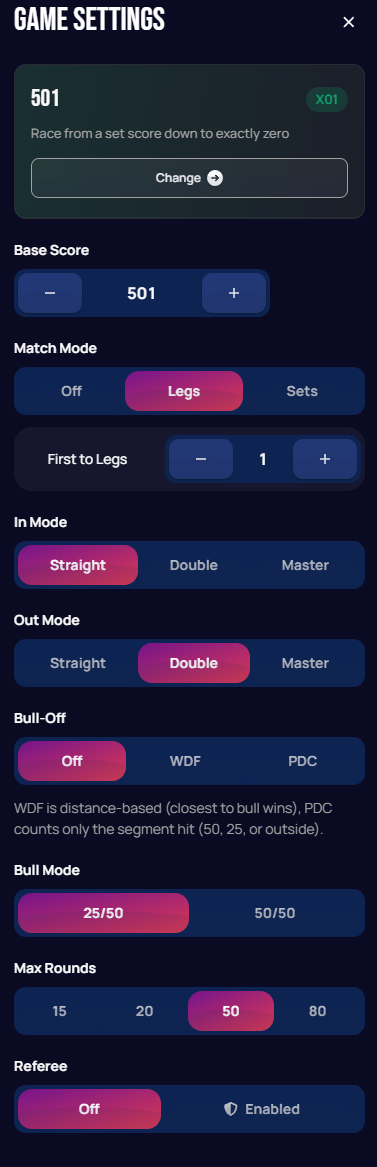
Selecting Edit settings in the lobby (or Change to switch into X01 from another mode) exposes the following options:
| Setting | Options | Notes |
|---|---|---|
| Base Score | 121 / 170 / 301 / 501 / 701 / 901 | The starting score each player counts down from. 121 and 170 aren't traditional X01 scores by name, but follow the same rules — useful for training checkouts in that specific range. |
| Match Mode | Off / Legs / Sets | Whether the match is decided by a race to a number of legs (each leg is one complete game) or sets (a group of legs). With Off, there's no race target — after each leg, players choose either Finish (save the match stats) or Next Leg to keep playing; there's no cap on how many legs can be played this way, it's entirely up to the players. |
| First to (Legs/Sets) | Stepper, default 1 | How many legs (or sets) are needed to win the match. |
| In Mode | Straight / Double / Master | The type of segment required to start scoring on a leg. Straight In means any dart counts immediately; Master In means it must land in a double or a treble. |
| Out Mode | Straight / Double / Master | The type of segment required to finish (checkout) a leg. Double Out is the traditional darts finish; Master Out also allows a treble to finish, not just a double. |
| Bull-Off | Off / WDF / PDC | A bull-off decides who throws first: each player throws one dart at the bullseye. WDF rules go by distance — whoever's dart lands closest to the center goes first. PDC rules only look at which ring you hit (50, 25, or outside the bull), not the exact distance. |
| Bull Mode | 25/50 or 50/50 | Scoring value(s) for the bullseye — 25 outer / 50 inner, or 50 for either ring. |
| Max Rounds | 15 / 20 / 50 / 80 | Caps how many rounds a leg can run before ending, to prevent an unfinished leg running indefinitely. |
| Referee | Off / Enabled | Only an Autodarts Plus member can switch this to Enabled, but it then applies to the whole lobby — players without Plus can be invited in and play with the referee too. Enabled disables manual score entry entirely: either player can call in Autodarts' AI via the robot button on the score row to review the darts thrown so far that turn (checkout darts, which bring a score to exactly zero, are reviewed automatically without being called), and a misread dart has to be challenged, with the challenge only sticking if your opponent confirms it too. Off means there's simply no referee, and you correct darts manually (see Playing Your First Game for how score corrections work) — except for Autodarts Plus members, who still see the robot button as a personal one-tap auto-correct even with Referee off, no challenge needed since you can just fix your own score. |
Recommended defaults for new players
The defaults you'll see when creating a new lobby are a solid starting point: 501, first to 1 leg, straight in, double out, bull-off off, 25/50 bull, 50 max rounds. See Playing Your First Game for a full walkthrough using these defaults.
X01 traces back to 301, originally scored on a cribbage board — "five times round" the board's holes came to 300, plus 1. As players got better, 301 games ended too quickly to be much of a contest, so 501 became the new standard. The extra 1 isn't just tradition: since a leg has to finish on a double (an even number), starting from an odd score forces at least one turn somewhere in the leg to land on an odd segment, instead of letting a player coast entirely on evens.